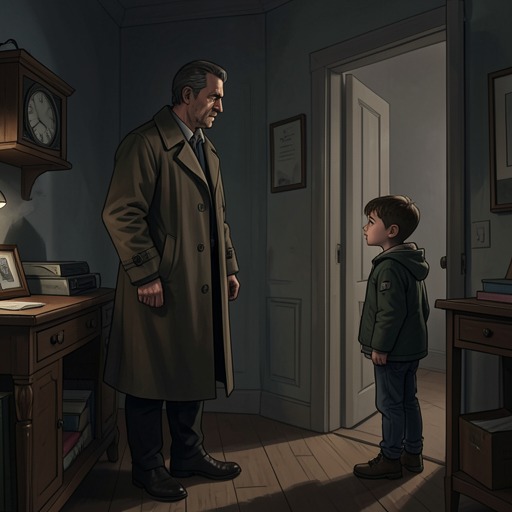
C. S. Lewis and his father
Surprised by JoyC. S. Lewis and his father were joined by affection and flashes of genial companionship, yet their relationship was increasingly marked by grief, embarrassment, and miscommunication. After Lewis’s mother died, the two boys turned inward toward each other while their father struggled with loss and an unpredictable temper. The adult memoirist does not reduce their estrangement to a simple accusation: he describes a father capable of warmth and generosity, but also a household in which confidence became difficult and ordinary exchanges could be transformed by rhetorical excess or mistaken interpretation.
Temperament and family background
Lewis presents the relationship against a contrast between his parents’ temperaments. His father’s Welsh family, in the account, was sentimental and passionate, readily moved to anger or tenderness; his mother’s Hamilton family was cooler, more critical and ironic, and more disposed to happiness. Lewis remembers his mother’s affection as cheerful and tranquil, while his father’s emotional life rose and fell. This early difference helped form Lewis’s own discomfort with intense emotion, which he experienced as embarrassing and potentially dangerous.
His father’s gifts were inseparable from the qualities that could complicate family life. He had a resonant voice, quickness of mind, eloquence, memory, and a taste for public speaking; he had worked as a public prosecutor and was an accomplished storyteller, acting out characters with gesture and grimace. His humor and appetite for anecdotes made him delightful company, but his command of rhetoric could also magnify a small domestic fault into a prolonged denunciation. Lewis later recognized that he had inherited some of this dramatic bent himself.
Bereavement and the brothers’ retreat
The decisive rupture came with Lewis’s mother’s illness and death. One night, while Lewis was ill and distressed that his mother had not come to him, doctors and movement through the house signaled that something serious was happening. His father entered in tears and tried to explain the illness. The cancer’s course included an operation at home, apparent recovery, a return of the disease, increasing pain, and death. Lewis says his father never fully recovered from the loss.
For the children, however, bereavement began before the death itself. Their mother was gradually removed from ordinary family life into the care of nurses and the effects of delirium and morphine; the home became strange and threatening to them. Lewis recalls that witnessing adult misery did not draw the boys closer to their father. Instead, their father’s anxiety made his temper unpredictable, and he sometimes spoke wildly or acted unjustly. Lewis speculates that the boys might have eased their father’s suffering had they been better children, but says they did not. He and his brother increasingly trusted only each other, and Lewis believes he was already learning to lie to his father. The loss thus had two linked effects: it divided father from sons, while drawing the brothers together as their main source of comfort.
Lewis’s memory of being taken to see his mother after her death further conveys the gap between adult intentions and a child’s experience. He understood the visit not as seeing his mother but as seeing a dead body, and found the funeral arrangements frightening rather than consoling. He even objected to mourning clothes in front of his aunt. Retrospectively, Lewis connects his reaction to a lasting distaste for public and collective forms, including formal observances. The episode matters to the father-son relationship because it shows how the family’s attempts to manage grief could leave the children feeling more alienated than included.
Discipline, privacy, and failed communication
The distance between Lewis and his father increased gradually after the bereavement. Lewis acknowledges both that no one was wholly to blame and that the boys bore some responsibility. His father was a widower still prostrated by loss, raising two noisy, mischievous boys who reserved their confidence for each other. He was too generous to strike them in anger and too impulsive to discipline them calmly by principle, so he relied on speech. When a boy had walked on wet grass in slippers or left the bathroom untidy, Lewis recalls, the reprimand could swell into an oratorical performance, complete with piled-up comparisons, questions, gestures, and pauses. Once, a pause lasted long enough that Lewis’s brother resumed reading, innocently believing the speech was over; their father took the gesture for deliberate insolence. The disproportion could be comic, but it also made discipline hard to meet as a straightforward exchange.
Privacy became a further obstacle. While beginning to practice Christianity at school, Lewis wrote a set of rules for himself and carried them in his pocket. During the holidays, his father noticed the papers bulging from his coat and began sorting through them. Lewis managed to keep his resolutions from view and burn them. He does not present either of them as culpable, but identifies that moment as the beginning of a lifelong routine: before entering his father’s house, he checked his pockets for anything he wanted to keep private. Concealment, in this telling, began before Lewis had anything guilty to hide; later, he found that even matters he might have wished to share were too risky, embarrassing, or difficult to explain.
The father’s earnest inquiries about school did not repair that distance. Lewis portrays him as intelligent and even touched by genius, yet capable of confusing an issue or misunderstanding a fact, particularly when settled in his armchair after a heavy midday meal. Sometimes he asked for information and forgot the answer; at other times he retained a distorted version, shaped by his own humor, sentiment, or indignation before he had properly heard what was said. Proper names were especially liable to change: a boy called Churchwood, who had kept a field mouse as a pet, became in his father’s retelling Chickweed, who was supposedly afraid of rats. Once adopted, the mistaken story resisted correction. His father might also infer elaborate hidden motives from other people’s actions, then hold to those conclusions with confidence. The examples make their communicative failure more than a matter of reticence: even when the sons spoke, their father could receive a story different from the one they had told.
Affection, companionship, and retrospective balance
The relationship was not defined by estrangement alone. Lewis stresses that his father’s spirits could rise as readily as they fell, and that his forgiveness was as complete as his displeasure. He could play the fool without guarding his dignity, and the young Lewis enjoyed his humor as one enjoys fine weather, without yet understanding how good company his father could be by adult standards. The memoir therefore holds two domestic experiences together: the father whose absences and misunderstandings helped the boys build a life apart from him, and the companion whose warmth could make time at home pleasurable.
A brief period when Lewis left Campbell College because of illness offers a particularly clear counterpoint. His father had become dissatisfied with the school and favored a preparatory school in Wyvern, partly because Lewis and his brother could continue travelling together. During the six weeks at home, Lewis slept in his father’s room and was spared much of the solitude that frightened him at night. With his brother away, there was no sibling mischief to provoke conflict, and Lewis remembers an unusually untroubled affection between them. When his father was out, the empty house also gave him satisfying solitude for reading, writing, and drawing. The recollection shows that closeness was possible under changed circumstances, even as it could not undo the broader pattern of secrecy and misunderstanding.
Lewis’s adult account preserves the bond by refusing to settle it into either filial accusation or uncomplicated affection. His father’s grief and volatility helped alienate the boys, while his rhetorical brilliance and interpretive habits made ordinary communication precarious. Yet his generosity, humor, forgiveness, and capacity for companionship remain just as present in the narrative. The relationship’s lasting shape lies in that unresolved conjunction: love endured, but the sons learned to protect their inner lives from the person who had once been their closest adult presence.